L'Inghilterra coltiva la vite vicino al limite della viticoltura: il disciplinare della DOP «English» ricorda che tutti i vigneti stanno sopra il 49,9° parallelo, in un clima temperato con poche giornate estive oltre i 30 °C e una forte escursione fra il giorno e la notte. Da queste condizioni nascono spumanti metodo classico da Chardonnay, Pinot Nero e Pinot Meunier, con un'acidità alta, e bianchi fermi profumati come il Bacchus.England grows vines close to the limit for viticulture: the specification of the «English» PDO notes that every vineyard lies above 49.9 degrees north, in a temperate climate with few summer days above 30 °C and a wide swing between day and night. These conditions produce traditional-method sparkling wines from Chardonnay, Pinot Noir and Pinot Meunier, with high acidity, and fragrant still whites such as Bacchus.
Il territorioThe territory
La terraThe land
Nel Sussex la maggior parte dei vigneti sta sulla creta dei South Downs, un calcare tenero di età cretacea, oppure sulle sabbie verdi (greensand) più a nord. In Kent, nei vigneti di Appledore, ci sono argille con sabbie e conchiglie nel sottosuolo; in Cornovaglia, lungo il fiume Camel, un sottosuolo di ardesia antica.In Sussex most vineyards sit on the chalk of the South Downs, a soft limestone of Cretaceous age, or on the greensand further north. In Kent, in the vineyards at Appledore, there are clays with sand and seashells in the subsoil; in Cornwall, along the River Camel, an ancient slate subsoil.
Il vitignoThe grape
Per lo spumante della DOP English il disciplinare ammette sei uve: Chardonnay, Pinot Nero, Pinot Nero Précoce, Pinot Meunier, Pinot Bianco e Pinot Grigio. Il vino fermo ha un elenco molto più ampio, dove spicca il Bacchus, un'uva profumata che qui dà bianchi secchi e freschi; in Cornovaglia la DOP Darnibole lo vuole in purezza.For sparkling wine under the English PDO the specification allows six grapes: Chardonnay, Pinot Noir, Pinot Noir Précoce, Pinot Meunier, Pinot Blanc and Pinot Gris. Still wine has a much longer list, in which Bacchus stands out, a fragrant grape that gives dry, fresh whites here; in Cornwall the Darnibole PDO requires it on its own.
L'uomoThe human hand
La viticoltura inglese moderna ha una storia recente: nel 1952 il maggior generale Guy Salisbury-Jones piantò viti sulla creta di Hambledon, nell'Hampshire, e nel 1988 Nyetimber mise a dimora in West Sussex le tre uve dello Champagne. Molti enologi e viticoltori del Sussex si sono formati al Plumpton College, e la Wine Standards della Food Standards Agency controlla i vini a denominazione.Modern English viticulture has a short history: in 1952 Major-General Guy Salisbury-Jones planted vines on the chalk at Hambledon, in Hampshire, and in 1988 Nyetimber planted the three Champagne grapes in West Sussex. Many of the winemakers and vineyard managers in Sussex trained at Plumpton College, and Wine Standards at the Food Standards Agency checks the wines that carry a designation.
La mappaThe map
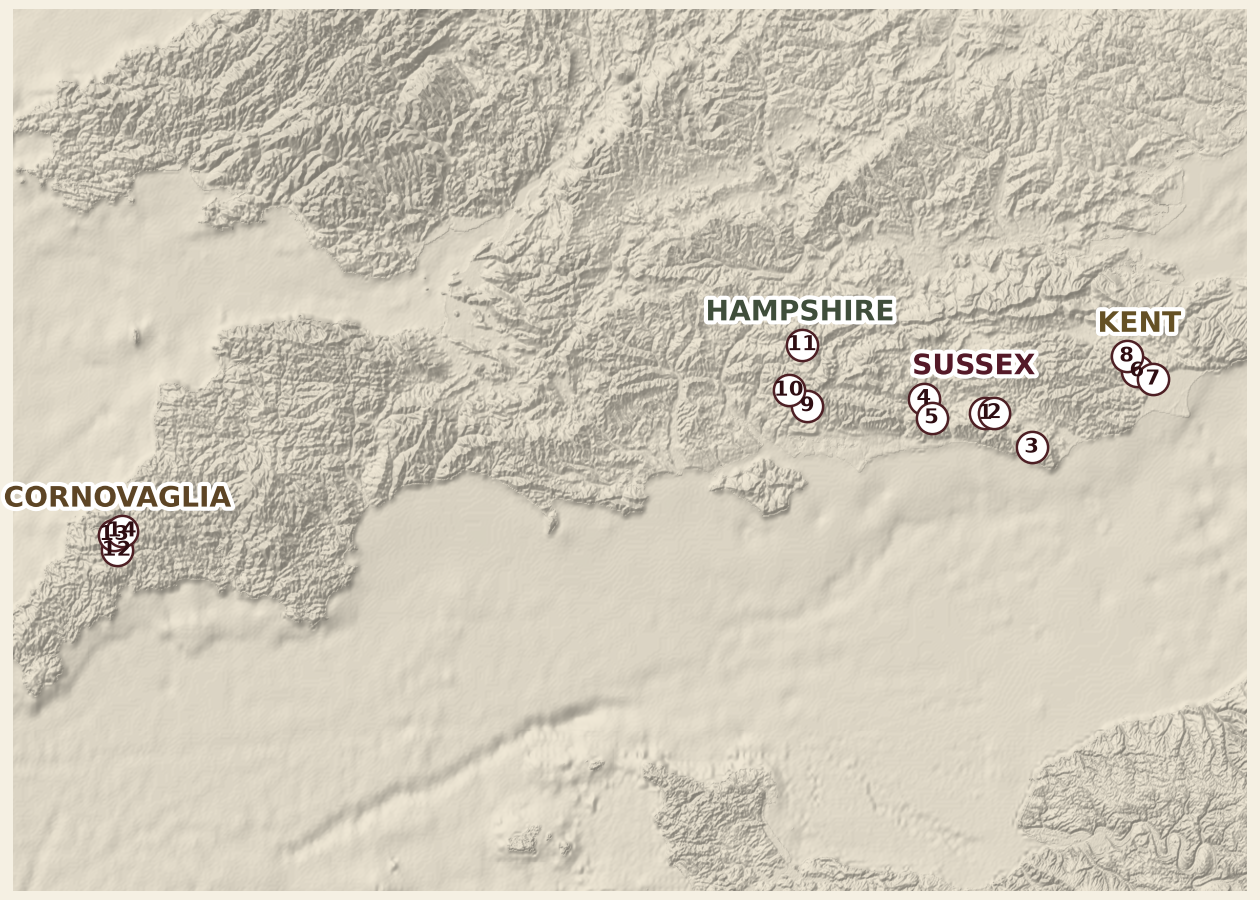
Quattordici parrocchie per leggere quattro distretti del vino inglese, da ovest a est: la Cornovaglia del fiume Camel, le colline di creta dell'Hampshire, i South Downs del Sussex e il Weald del Kent.Fourteen parishes to read four English wine districts, west to east: Cornwall along the River Camel, the chalk hills of Hampshire, the South Downs of Sussex and the Weald of Kent.
- 1 Ditchling
- 2 Plumpton
- 3 Alfriston
- 4 West Chiltington
- 5 Washington
- 6 Tenterden
- 7 Appledore
- 8 Biddenden
- 9 Hambledon
- 10 Exton
- 11 Wield
- 12 Lanivet
- 13 Egloshayle
- 14 St Mabyn
Zone e sottozoneZones and subzones
I vitigni del territorioThe grapes of the territory
Le denominazioniThe denominations
A tavolaAt the table
Sulla costa del Kent, a nord di Whitstable, si allevano le Whitstable Oysters, un'IGP che comprende l'ostrica piatta nativa e quella concava. Crude, con il loro gusto di mare, chiedono uno spumante metodo classico secco a prevalenza di Chardonnay: la freschezza e le bollicine ripuliscono la bocca a ogni ostrica senza coprirne il gusto delicato.On the Kent coast, north of Whitstable, Whitstable Oysters are farmed, a PGI that covers both the native flat oyster and the cupped one. Eaten raw, with their taste of the sea, they call for a dry traditional-method sparkling wine led by Chardonnay: the freshness and the bubbles clean the palate with every oyster without covering its delicate taste.
In Cornovaglia le sardine della pesca locale (le Cornish Sardines, un'altra IGP) si cuociono alla griglia e sono un pesce grasso e saporito. Il bianco giusto è un Bacchus secco della stessa terra, come quelli della valle del Camel: la sua acidità viva pulisce il palato dal grasso del pesce, e il profumo accompagna la griglia senza coprirla.In Cornwall the sardines of the local fishery (Cornish Sardines, another PGI) are grilled and make a rich, full-flavoured oily fish. The right white is a dry Bacchus from the same land, like those of the Camel valley: its lively acidity cleans the palate of the fish's oil, and its fragrance goes with the grill without covering it.
Il Cornish pasty, anch'esso IGP, è un fagottino di pasta a forma di D ripieno di manzo, patate, rapa svedese e cipolla, chiuso crudo e cotto lentamente. È sugoso e ricco: sta bene con uno spumante rosé metodo classico, fresco e vivace, oppure con un Pinot Nero inglese fermo e leggero, di tannino morbido, che risponde al sugo della carne.The Cornish pasty, also a PGI, is a D-shaped pastry parcel filled with beef, potato, swede and onion, sealed raw and baked slowly. It is juicy and rich: it goes well with a fresh, lively traditional-method rosé, or with a light still English Pinot Noir with soft tannins, which answers the juices of the meat.
La storiaHistory
Il 17 dicembre 1662 un medico londinese, Christopher Merrett, presentò alla Royal Society, fondata da poco, un breve saggio dal titolo «Some observations concerning the ordering of wines». Merrett non era un vignaiolo: dal 1654 era il primo custode della biblioteca harveiana del Royal College of Physicians, e osservava il vino come osservava tutto il resto, con occhio da naturalista.On 17 December 1662 a London physician, Christopher Merrett, presented a short paper to the recently founded Royal Society under the title «Some observations concerning the ordering of wines». Merrett was not a winegrower: since 1654 he had been the first Harveian librarian of the Royal College of Physicians, and he looked at wine the way he looked at everything else, with a naturalist's eye.
Nel saggio scrisse che i bottai e i cantinieri di Londra aggiungevano «grandi quantità di zucchero e melassa» a ogni genere di vino «per renderlo vivace e spumeggiante». Lo zucchero faceva ripartire la fermentazione e l'anidride carbonica restava nel vino; a reggere la pressione aiutava, ricorda il Royal College of Physicians, un vetro più spesso e resistente. Il saggio fu stampato a Londra nel 1669, dentro «The mysterie of vintners», e il Royal College of Physicians lega ancora oggi il nome di Merrett agli inizi dello champagne.In the paper he wrote that London's coopers and cellarmen added «vast quantities of Sugar and Melosses» to all sorts of wines «to make them drink brisk and sparkling». The sugar restarted fermentation and the carbon dioxide stayed in the wine; thicker, stronger glass, the Royal College of Physicians notes, helped to hold the pressure. The paper was printed in London in 1669, in «The mysterie of vintners», and the Royal College of Physicians still links Merrett's name to the beginnings of champagne.
La viticoltura commerciale inglese di oggi, invece, è una storia del Novecento: nel 1952 il maggior generale Guy Salisbury-Jones piantò un vigneto sulla creta di Hambledon, nell'Hampshire, e nel 1988 una tenuta del West Sussex già citata nel Domesday Book del 1086, Nyetimber, mise a dimora Chardonnay, Pinot Nero e Pinot Meunier sotto i South Downs. Da quelle prove è nata la viticoltura di oggi, che nel 2011 ha avuto la sua DOP nazionale e nel 2022 la DOP del Sussex.Today's commercial English viticulture, by contrast, is a twentieth-century story: in 1952 Major-General Guy Salisbury-Jones planted a vineyard on the chalk at Hambledon, in Hampshire, and in 1988 a West Sussex estate already named in the Domesday Book of 1086, Nyetimber, planted Chardonnay, Pinot Noir and Pinot Meunier beneath the South Downs. Today's viticulture grew from those trials, and it gained its national PDO in 2011 and the Sussex PDO in 2022.
Numeri e denominazioni vengono dal registro ufficiale dei nomi protetti per il vino del DEFRA (gov.uk) e dai disciplinari delle DOP English, Sussex e Darnibole e dell'IGP English Regional pubblicati lì; i piatti di «A tavola» sono indicazioni geografiche dello stesso registro. La notizia su Christopher Merrett viene dal Royal College of Physicians; quelle su Hambledon e Nyetimber dalle pagine storiche delle due tenute. Le descrizioni di suoli e stili sono nostre e non hanno valore normativo.Figures and designations come from DEFRA's official register of protected wine names (gov.uk) and from the specifications of the English, Sussex and Darnibole PDOs and the English Regional PGI published there; the dishes in «At the table» are geographical indications from the same register. The account of Christopher Merrett comes from the Royal College of Physicians; those of Hambledon and Nyetimber from the two estates' history pages. Descriptions of soils and styles are our own and carry no regulatory weight.